
Before university, we students were always taught there a simple scientific method that should be followed – make an observation, form hypotheses, test them using controlled and systematic experiments, then see if the results support your hypotheses. the new hypotheses are formed accordingly, and continuous data collection and analysis eventually culminated in ‘reliable’ theories. Now that I am specifically studying evolutionary ecology, I am realising that an inherent problem with this field is that it can be difficult to test in a natural environment, because lots of time and generations are needed to observe evolutionary dynamics. I will inevitably face this disadvantage many times in my research career and have had to deviate from this classic hierarchy of processes. This raised the question, is this umbrella term – ‘the scientific method’ – still relevant to everyday scientific practice?
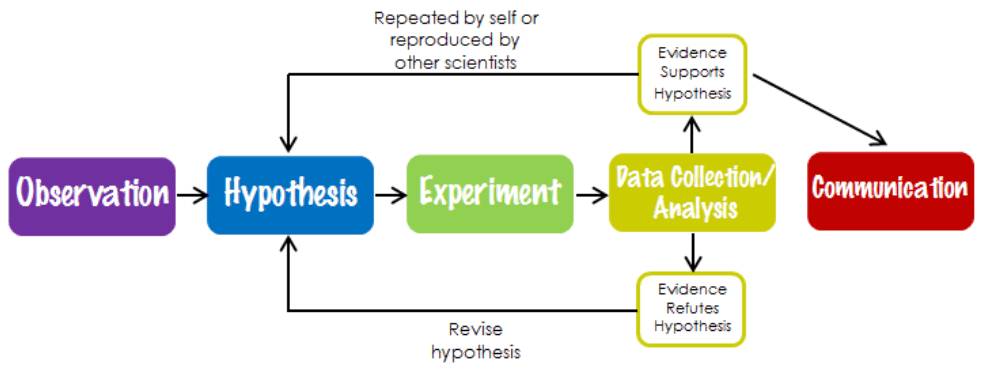
Apparently, I’m not the only one who has come to this conclusion – this question has actually been under scrutiny for many decades. Many argue that this unrealistic process has created problematic pseudoscience based on the premise that something cannot be real science if it does not fit that particular description of science because there is only one scientific method. Sounds confusing, but one example would be that creationists argue that evolution does not exist as it cannot be observed. Overall, many diverse methods exist that can be applied to various contexts and different types of science, which is what I will try to explain here.
Firstly, many of the original concepts in ‘a scientific method’ are irrelevant to modern science. For example, the process of induction, which was formulised by an empiricist, Francis Bacon, in the seventeenth century, is where individual pieces of evidence are collected and examined until a law is discovered or a theory is invented. The problem with induction is that carefully accumulated evidence does not always result in sure knowledge. It is impossible to make every observation and collect every relevant fact for every occasion throughout all of time, but only by these means can a definitive conclusion be made. The scientific method can often involve laws and theories that promise to hold true in all time and contexts, but this guarantee is impossible. For instance, laws of biology are likely confined to Earth and would not hold true on other planets where life has evolved. Ultimately, induction can never attain true knowledge because subsequent observations may oppose the theory even if the previous one million had not.
The meaning of a ‘scientific method’ is not universally applicable because it varies between each branch of science. Fundamentally, the only similarity between disciplines is that the science is valid only so long as it is not refuted by nature. The range and effectiveness of scientific methods has expanded over time with technological advancements, the rate of which differs between areas of science. Ease of data collection and the degree of importance put on evidence compared to theory also varies between different sciences. Direct experimentation and replication is not the sole route to knowledge for some sciences, which leads to the term ‘scientific method’ being misconceived. For example, volcanic eruptions or earthquakes cannot be replicated in an experiment and thus do not follow the typical steps in a scientific method. Extensive observations and other non-experimental approaches have been used instead for some areas, such as evolution, field ecology and astronomy. This is because experiments can be difficult to execute – some variables cannot be controlled, and cause and effect relationships can be challenging to establish. Also, some phenomena cannot be observed directly. For example, the core of a planet cannot be reached, but science can be applied to deduce what is likely to be happening. Evidently, each type of science varies in its dependence on repeated observations, analysis, mathematical modelling and literature investigation. Therefore, there cannot be only one scientific method.
Scientific methods are complicated and influenced by external elements, such as teaching background and the current understanding of scientific literature. Like all humans, scientists tend to jump to conclusions based on flimsy evidence and have biased views and preconceptions. Collecting and inferring facts without bias is impossible because subconscious notions affect scientists’ ability to make observations. Additionally, due to differences in prior knowledge, two individuals reviewing the same data might not reach the same conclusion. This suggests that following a scientific method fails as soon as one’s perception interferes with data interpretation. Arguably, ‘the scientific method’ could simply be a myth because scientists investigate issues using qualities common in all effective problem-solvers. Scientists, and therefore their methods, vary in objectivity, scepticism, patience and care. Variation in competence, dedication and honesty challenges the existence of a single scientific method, but there is scant attention on how practicing science is influenced by the fact that scientists vary in ability.
Ultimately, the idea that a single scientific method exists as a series of discrete processes is misleading. The purpose of a scientific method had traditionally been to narrow down many hypothetical truths to a single truth, but science does the opposite. Scientific enquiry leads from single unequivocal truths to multiple, relative, uncertain ones through exponential growth of information, theories and hypotheses. This process cannot be determined by following a simple set of rules – scientific enquiry requires developing skills in deciding what to observe, selecting which observations are important, interpreting data, replicating experiments and determining how a study is influenced by other interests and commitments. Theoretically, there is no distinct scientific method at all. There are general cognitive skills used in all processes of systematic investigation and common-sense reasoning which is routinely used throughout everyone’s lives without method nor association with science. Nevertheless, the scientific method should not be entirely disregarded as a myth but should instead be viewed as an ideal. Changing the understanding of ‘the scientific method’ could have constructive consequences for the development of scientific knowledge and for science’s role in human culture.
References
Bauer, H.H., 1992. Scientific Literacy and the Myth of the Scientific Method. Urbana: University of Illinois Press.
McComas, W.F., 1998. The principal elements of the nature of science: dispelling the myths. In The Nature of Science in Science Education, pp.53-70. Springer, Dordrecht.
Millar, R., 1994. What is ‘scientific method’ and can it be taught? Teaching Science, pp.164-177.
Nuzzo, R., 2014. Scientific method: statistical errors. Nature News, 506(7487), pp.150-152.
Pirsig, R.M., 1999. Zen and the Art of Motorcycle Maintenance: An Inquiry into Values. Random House.
 Alice's Arms Race