
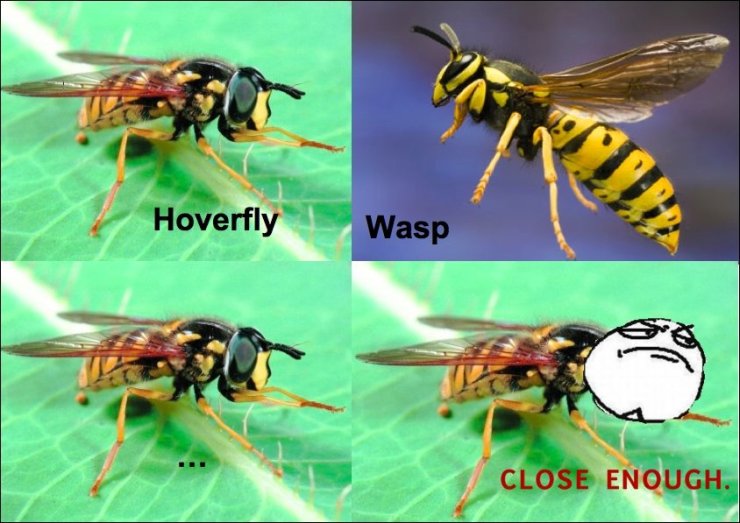
Have you ever flinched from a wasp? Maybe screamed and danced about for a little? But then realised that it is just hovering there, rather than darting about like a crazy beast waiting to sting? ‘Oh, it’s just a hoverfly…’ you say, still feeling a bit disgusted that this bug has landed on your sandwich, but slightly relieved that there is no chance of it hurting you. Well, there is a reason why this harmless hoverfly looks like the fearful wasp! But, more importantly, there are many reasons why it doesn’t look much like a wasp at all. The amount of research that has gone into why hoverflies can often mimic wasps so poorly is phenomenal, stretching back to at least one hundred and fifty years ago.
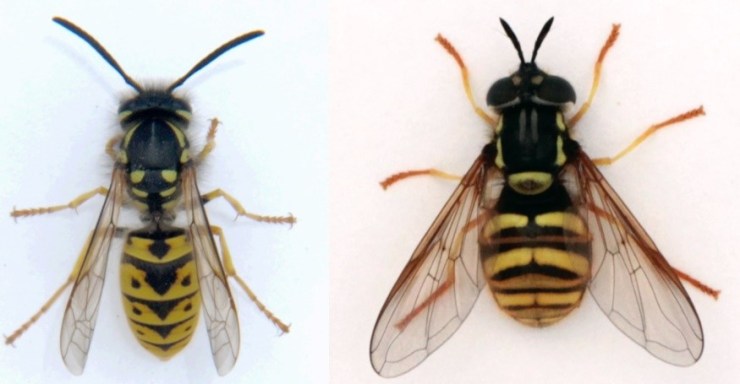
Figure 1 – Left: ‘Common Wasp’, Vespula vulgaris. Right: British hoverfly species, Chrysotoxum arcuatum. If these two were flying around you may mistake them for the same insect at first glance. Only now when you look at them side by side do they look completely and obviously different!
Despite the abundance of attention from the scientific community of evolutionists and ecologists, my masters project will attempt something that has never been done before in this mimicry system – mapping how mimetic accuracy has evolved along the evolutionary tree of the hoverflies. Not only this, but I will be using a recently developed technique to objectively determine the true state of mimicry for every hoverfly across the entire Northern hemisphere (known as the Holarctic region), including those that have never been reviewed before! I can then conclude whether past literature has accurately judged the precision of mimicry. Once I have completed these exciting tasks, my project could change how this well-studied Batesian mimicry complex is researched in the future. Only by investigating the evolution of mimetic phenotypes can we better understand the ecological forces that drive inaccurate mimicry in nature.
My work has hardly begun, but the potential of this research is invigorating. Other than focusing on the other modules I am taking this academic term, I have mainly been working on a grant proposal for this project. Now that that is out of the way, I have time to explain what I am going to be doing over these next few months.
The first part is the most arduous. I need to a find good quality image for each of the 108 hoverfly genera that live in the Holarctic region. I anticipate that I will come across many challenges – there can sometimes be so much colour pattern variation between individuals that it is difficult to find one image which best represents every other image simultaneously (Figure 2a). Furthermore, some genera are rare or have considerable phenotypic sexual dimorphism (where males and females differ significantly in appearance – see Figure 2b).
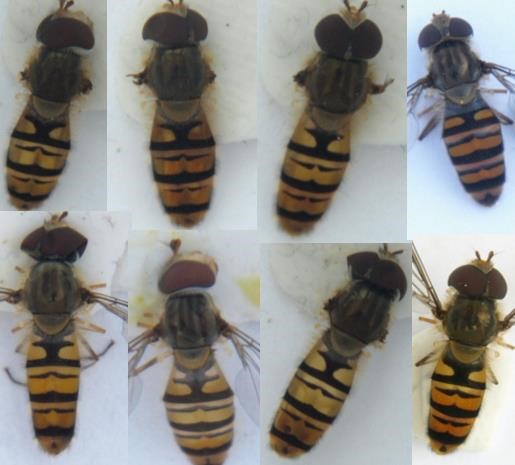
Figure 2a – These are just 8 of the 143 images I have for Episyrphus balteatus, which is one of the most common hoverfly species in Britain. In the end, I chose the bottom right image to represent the species based on image quality and how much the pattern was similar to every other individual.
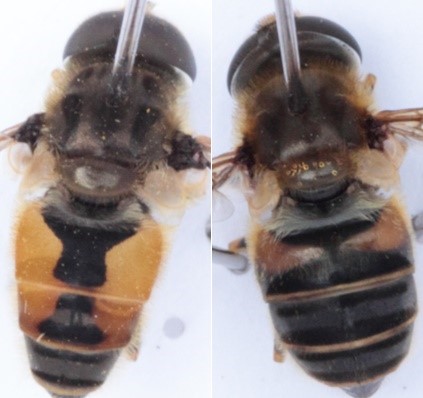
Figure 2b – Eristalis arbustorum provides a key example of how sexual dimorphism can be problematic when trying to pick one image to represent the colour pattern for an entire genus. Left: male. Right: female.
To quantify the similarity between the wasp model image and each hoverfly image, I must first convert the abdomen colour pattern into a binary image (Figure 3). This is done using a computer program called MATLAB, which analyses each individual pixel to work out whether it is part of the outline (blue), black part of the abdomen (red) or part of the colour pattern (unedited). The program will then produce a matrix – a series of scores for each image which represents how similar the wasp and hoverfly patterns are. This process of image collection and processing will alone take a couple of months!
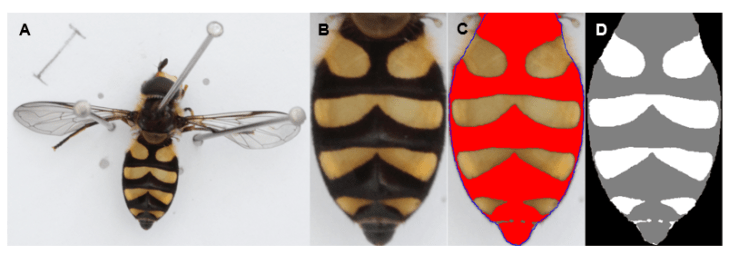
Figure 3 – The stages of image pre-processing: A) Original image. B) After rotation, cropping and scaling. C) Abdomen outlined in blue and black areas masked with red using ImageJ (a photo editing program). D) The binary image from MATLAB where white areas correspond to yellow parts of the colour pattern.
Afterwards, I can plot these scores onto the phylogenetic tree of the hoverflies and determine how mimicry has evolved. The final part of the project will inevitably be to interpret what all of the results means and write up an awesome paper!
 Alice's Arms Race