
Rather tricky topics of controversy have often involved the arguments of creationists and the scientific community. While this blog will not be getting into the nitty-gritty of this ongoing theological dispute, it will introduce you to an interesting character that has been caught up in the debate: The Bombardier beetle. Its toxic defence mechanism could prove to be a rather explosive entry for this month’s blog post!
These ground beetles can be one of over 500 species from the Carabidae family and are found in all continents except Antarctica. They live in any habitats moist enough to lay eggs, such as woodlands and grasslands in temperate zones. But enough of the boring stuff – what exactly is it that makes these beetles such a heated (one could almost say boiling) topic of debate…? Watch below to find out!
So, by now you might be wondering how a defence this strong exists in such a tiny creature (here comes the science). Inside the beetles’ abdomen two chemical compounds, hydrogen peroxide and hydroquinone, are stored in separate reservoirs, which are connected to a thick-walled reaction chamber via a muscle-controlled valve (see the diagram below; image credit to Scott Mauser). The chamber is lined with cells that secrete peroxidases and catalases. These enzymes facilitate the oxidation of the hydroquinone and the decomposition of the hydrogen peroxide. This exothermic reaction generates enough heat to boil the mixture, which produces a gas. The surmounting pressure from the released gasses causes the chemical liquid to be explosively expelled out of the opening at the tip of the abdomen!
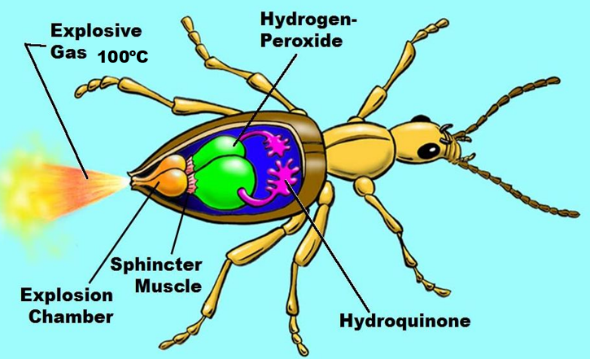
This venomous squirt could travel up to 20cm which, considering these beetles are only around 2.5cm long, is quite a considerable achievement! Typically, these beetles turn their whole body to direct the spray towards the threat, but some African bombardier beetles can twist the gland opening through 270° to aim with considerable accuracy in a wide range of directions. The entire sequence takes just a fraction of a second and can be fatal for predators that trigger the response. Sometimes, it is even enough to cause the predator to vomit up the beetle after it has been eaten….
The complexity of this defence mechanism has stirred up debate amongst creationists and evolutionary biologists for several decades. For those of you who do not already know, creationism is typically defined as the religious belief that life originated from divine creation. Some creationists believe the bombardier beetle to be an example of irreducible complexity, which is the concept that some biological systems cannot evolve by accumulated microevolution – the process of small, successive modifications to pre-existing functional structures via natural selection. This is central to the creationist idea of intelligent design, but this is refuted by evolutionary biologists.
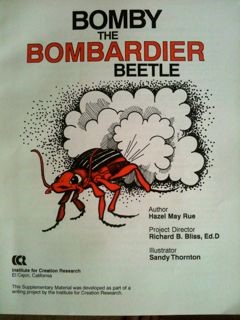
Weaknesses in this argument come from inaccurate accounts of the process in creationist literature. In 1981, Dr Duane Gish, an American biochemist, claimed that hydroquinones and hydrogen peroxide spontaneously explode if they are combined without a chemical inhibitor. He stated that this beetle begins with a mixture of all three compounds and adds an anti-inhibitor when it needs to defend itself. This theory of spontaneous combustion is false and the use of four different compounds to explain this mechanism makes it unnecessarily complex. In a creationist children’s book from 1984, the author claims that the liquid doesn’t explode until it is outside the beetle. Actually, the explosions must occur inside the reaction chamber so that its force can be directed towards the threat. As you can see, these arguments are fairly old and based off of a lack of thorough empirical evidence.
Evolutionary biologists have since argued that the defence mechanism could be explained by a series of microevolutionary steps:
- Epidermal cells produce quinones for tanning the cuticle or for use as distasteful secretions in predator defence in a variety of arthropods. Various insects develop different defensive chemicals, such as hydroquinone, when having to defend against predators resistant to quinone.
- The development of reservoirs from deep pockets in the epidermis allows insects to expel the quinones when they are needed.
- Hydrogen peroxide is commonly produced during cellular metabolism as a by-product.
- The cells that secrete hydrogen peroxide and hydroquinone retract from the surface of the reservoir and eventually become a separate organ. These glands connect to reservoirs by ducts specialised for transporting hydroquinone. This configuration of glands and reservoirs exists in many beetles.
- Along the output passage of the reservoirs, cells which secrete catalases, and peroxidases start to develop outside of the valve which closes it off from the outside. Almost all cells produce catalases, and peroxidases are produced in most plants, animals, and bacteria.
- The output passage then shapes into a reaction chamber and its walls toughen to better withstand the high pressure and temperature that is generated by the reaction.
The true evolution of this complex structure probably did not happen exactly like this, but it shows that its evolution is far from impossible. All these hypothetical steps could be advantageous and therefore favoured by natural selection, meaning that no improbable events are needed to explain its evolution. For example, this spray is formed from pulsations caused by repeated micro-explosions at a rate of over 500 times per second. By using this pulsing mechanism, the beetles’ save energy because it uses pressure instead of muscles to expel the toxic jet at a constant velocity. Furthermore, the beetle Metrius contractus provides evidence for how this mechanism could have evolved gradually as a kind of ‘missing link’ or intermediate stage in the evolutionary process because it produces a bubbling, foamy discharge, which produces a fine mist, rather than jets.
Ultimately, the full evolutionary history of this defence mechanism is largely unknown – determining true sequence of development requires more research into palaeontology, comparative anatomy and genetics of these beetles. However, it is safe to say that the argument made by creationists that evolution cannot explain this bizarre defence have been successfully countered.
References
Arndt, E.M., Moore, W., Lee, W.K. and Ortiz, C., 2015. Mechanistic origins of bombardier beetle (Brachinini) explosion-induced defensive spray pulsation. Science, 348(6234), pp.563-567.
Di Giulio, A., Muzzi, M. and Romani, R., 2015. Functional anatomy of the explosive defensive system of bombardier beetles (Coleoptera, Carabidae, Brachininae). Arthropod Structure and Development, 44(5), pp.468-490.
Eisner, T., Aneshansley, D.J., Eisner, M., Attygalle, A.B., Alsop, D.W. and Meinwald, J., 2000. Spray mechanism of the most primitive bombardier beetle (Metrius contractus). Journal of Experimental Biology, 203(8), pp.1265-1275.
Schaller, J.C., Davidowitz, G., Papaj, D.R., Smith, R.L., Carrière, Y. and Moore, W., 2018. Molecular phylogeny, ecology and multispecies aggregation behaviour of bombardier beetles in Arizona. PloS One, 13(10), p.e0205192.
Sugiura, S. and Sato, T., 2018. Successful escape of bombardier beetles from predator digestive systems. Biology letters, 14(2), p.20170647.
 Alice's Arms Race