The development of a coevolutionary arms race between distasteful models and their Batesian mimics has long been hypothesised. Despite abundant research on how models affect mimic evolution, work on how a mimicry complex influences the evolution of models has been scarce. A recent study on coral snakes has overturned a common perspective by focusing on the model and whether it experiences ‘chase-away’ selection.


This study combines my project topic, Batesian mimicry evolution, with my favourite part of evolutionary ecology, coevolutionary arms races, so I thought this would be an ideal paper to start the blog off with!
Coevolutionary arms races can arise when a species evolves defences against an antagonistic species, who then invests in a counter-adaptation. This process could develop into the continuous evolution of reciprocal countermeasures to avoid extinction. This important concept has only recently begun to be applied to the well-studied phenomena of Batesian mimicry, which is often referred to as one of the first examples of Darwin’s theory of evolution by natural selection. Batesian mimicry occurs when a harmless species derives protection from predators due to its resemblance to a noxious species. When a predator encounters an unpalatable model species, they remember the nasty experience and then avoid that colour pattern in the future. By studying Batesian mimicry, we have an excellent opportunity to acquire a greater understanding of which ecological forces determine how phenotypes evolve.
These two evolutionary occurrences are related because selection for increasing mimetic resemblance could hypothetically be opposed by reciprocal selection in favour of distinct model phenotypes, leading to a coevolutionary arms race. When mimics increase in abundance, predators have more pleasant experiences of tasty mimics and remember that colour pattern as profitable, so protection from mimicry breaks down. This is disadvantageous for the model as it also begins to experience increased predation. Consequently, models may experience higher selection pressures to evolve phenotypes that differentiate themselves from their ‘parasitic’ mimics. This is known as ‘chase-away’ selection and is the subject in question for this recent paper, which was published in August this year.
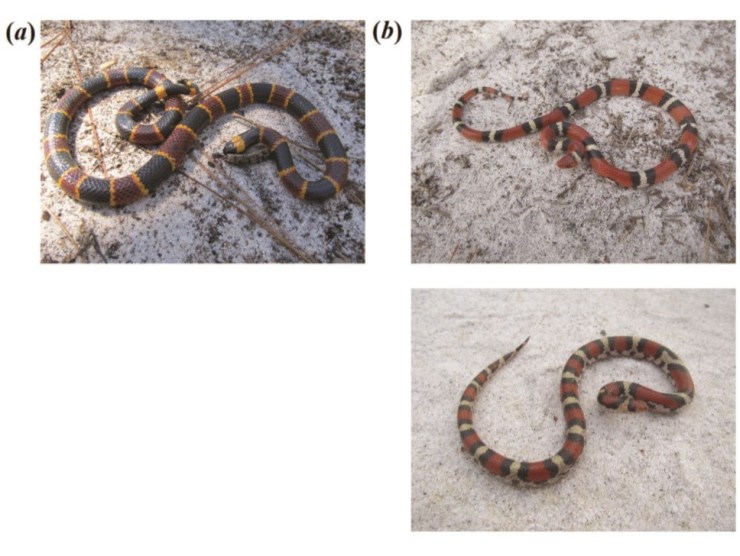
Akcali and colleagues carried out a study on the coral snake mimicry complex in the USA (Figure 1). Previously recorded geographical variation in phenotypic resemblance between the eastern coral snake model and its mimics could suggest that populations are at different points in chase-away evolution. However, this study found no evidence of chase-away selection and the data did not support the hypothesis that model fitness is negatively impacted by their Batesian mimics. Ultimately, models and mimics do not coevolve in this mimicry complex and chase-away selection is unlikely to explain why mimic–model similarity exhibits geographical variation.
Although this is not the race through time you might have been hoping for, this outcome is in fact rather interesting! This mimicry complex appeared primed for a coevolutionary arms race, so theoretical studies about Batesian mimicry might have overestimated how common or strong chase-away dynamics are in natural systems. So, why is there no snake chase?
Firstly, mimics should evolve faster because models experience weaker selection to evolve away from their mimics than mimics experience to converge on their models. Hence, chase-away selection is more likely if models are subjected to particularly strong fitness trade-offs between phenotypes. For example, hosts in egg mimicry complexes face losing an entire clutch of eggs if they fail to recognize and reject foreign eggs from avian brood parasites.
Secondly, strong stabilizing selection is expected to maintain the effectiveness of model warning signals by counteracting any chase-away or directional selection, especially when predators have an innate aversion to aposematic prey, which is the case for coral snakes. Theory predicts to enhance the ability of predators to recognize and avoid warning signals, predation selects for uniformity of such signals. Therefore, once a warning signal has evolved, predator-mediated selection favours the most common phenotype and models are prevented from evolving away from mimics.
So… was this study actually any good? My only suggestion for improvement would perhaps have been to use the distance transform method (Taylor et al., 2013) to calculate the similarity value between the model and mimic species. The common principal component analysis used in this paper summarises red and black colour proportions into one variable, whereas the distance transform method would have captured more information since it uses the entire colour pattern pixel by pixel. Overall, it was an interesting read which highlighted how it can be useful to flip the perspective on hypotheses, which is the important take-home message for non-specialist scientists. By considering other members of interactions, we could gain a better understanding of an entire system. This innovative way of thinking should be applied to other mimicry complexes, or any additional areas of science!
For more information, please follow this link to the original article:
Akcali, C.K., Kikuchi, D.W. and Pfennig, D.W., 2018. Coevolutionary arms races in Batesian mimicry? A test of the chase-away hypothesis. Biological Journal of the Linnean Society, 124, pp.668-676. https://academic.oup.com/biolinnean/article/124/4/668/5040331
Other references
Pfennig, D.W. and Kikuchi, D.W., 2012. Competition and the evolution of imperfect mimicry. Current Zoology, 58(4), pp.608-619.
Taylor, C.H., Gilbert, F. and Reader, T., 2013. Distance transform: a tool for the study of animal colour patterns. Methods in Ecology and Evolution, 4(8), pp.771-781.
 Alice's Arms Race